 Web HostingBudget-friendly shared hosting plans
 Domains SearchFrom .com to unique country domains, explore and register extensions worldwide.
 WordPress HostingPower your blog or business with WordPress hosting.
 Email HostingSimple, secure email hosting that helps you stay connected and professional.
 Reseller HostingStart your own hosting business with easy and reliable reseller hosting plans.
 AffiliateJoin our affiliate program and earn commissions every time you bring in new customers.
 cPanel HostingHosting powered by cPanel, the world’s most user-friendly control panel.
 Windows HostingBuilt for Windows applications and websites
 IN Domain PricesDon’t miss out on the best domain deals in India!
 WHOIS LookupFind out who owns a domain name with a quick and easy WHOIS search.
 Domain TransferTransfer your domain to us and enjoy reliable support every step of the way.
 .Com DomainGet the most trusted domain for worldwide credibility
 All TldsSearch and register domain extensions worldwide.
 SSL CertificatesProtect your website with trusted SSL certificates and keep customer data safe.
 VPS HostingPowerful virtual servers. Full root access. Reliable uptime.
 Managed VPS HostingNot a tech expert? Choose our fully managed VPS service.
 Dedicated ServersTake full power and total control of your own physical server.
 AI Website BuilderCreate stunning websites instantly with our easy AI builder.
 Online ShopBuild your eCommerce store easily, no coding, just growth.
 Web Design ServicesGet a website built for your brand and designed for your goals.
 Contact UsReach out to us for support or questions.
 SupportGet answers and how-to guides for all our services.
 BlogRead our latest blogs on web hosting, online business, digital marketing, and other helpful topics.
Someone just stole a domain that should’ve been yours.
Or a competitor registered it while you were thinking about it, and now they want ₹5 lakhs to sell it back.
Sounds familiar? Don’t worry.
Most mistakes happen in the first 24 hours, perhaps due to rushed decisions, overlooked details, and small errors with permanent consequences.
The good thing is that these mistakes are preventable.
But people make them constantly because domain registration feels simple, and they rush through it.
Thankfully, in this guide, I’ll walk you through each mistake, why it happens, and exactly how to avoid it.
Common Domain Registration Mistakes
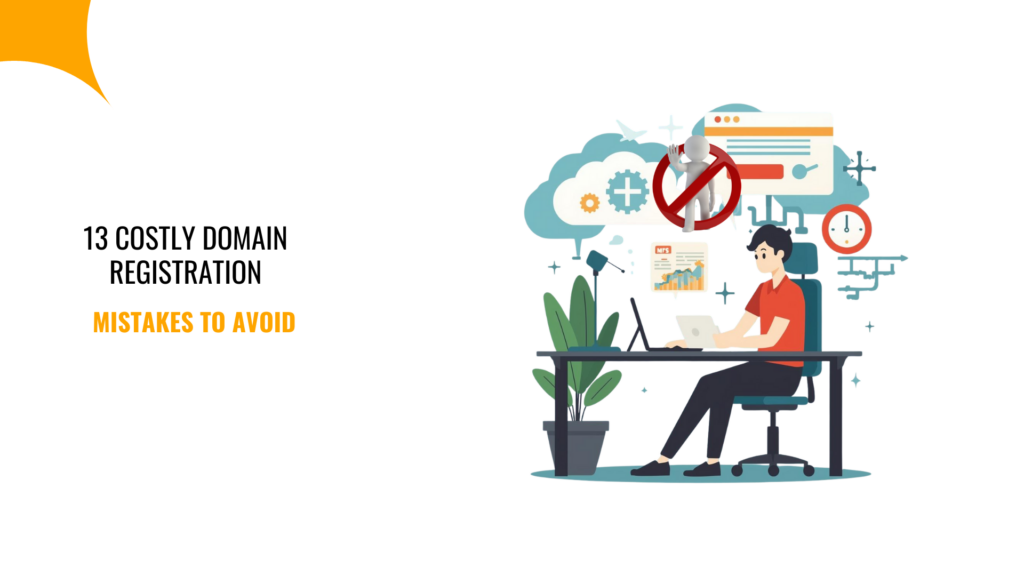
Domain registration takes five minutes.
But those five minutes determine years of your online presence.
Every mistake comes from real cases, which affect many people here in India. Some lost money. Others lost brand equity. A few lost everything and had to start over.
Let’s break down each one so you cannot be the next victim.
1) Choosing a Complicated or Hard-to-Spell Domain Name
The simple rule is that if you can’t say your domain clearly in a noisy room and have someone type it correctly first try, it’s too complicated.
So, stick with short, pronounceable words. Avoid numbers unless they’re part of your established brand.
Likewise, skip special characters entirely.
For example, “SharmaConsulting.in” beats “Sharma’s-Consulting-4-U.co.in” every time.
In short, test your domain choice by saying it to five people who’ve never heard it. Ask them to write it down.
If more than one person gets it wrong, simplify further.
2) Ignoring Local Domain Extensions (.in, .co.in)
Many businesses default to .com because it’s familiar.
They skip .in entirely, which is a big mistake if you’re targeting Indian customers.
Perhaps if you don’t know, let me tell you!
Google’s algorithm gives a slight preference to local domain extensions for geographic searches.
That means someone in Mumbai searching “web hosting” sees .in domains ranked higher than identical .com domains.
Beyond SEO, Indian customers trust .in and .co.in extensions more for local transactions.
E-commerce especially benefits from .co.in credibility because the extension tells customers you’re operating under Indian jurisdiction and regulations.
3) Registering a Domain Without Future Business Planning
You register “mumbaifoods.in” because you’re starting a restaurant in Mumbai.
Business grows. You expand to Pune, then Delhi.
Now your domain name limits you geographically, and rebranding costs lakhs in marketing to rebuild recognition.
Or you choose “sharma-electricals.in” for your electrical shop. Three years later, you add plumbing services.
Then, your domain doesn’t reflect half your business anymore.
This means you should always think five years ahead when choosing domains. Where will your business be? What services might you add?
Plus, ask which markets you will enter in the future.
For instance, generic domain names are often better than specific ones. That is, “SharmaServices.in” accommodates growth better than “SharmaElectricals.in” even if you start with just electrical work.
In short, your domain should have room to expand without becoming misleading or requiring expensive rebranding.
4) Not Checking Trademark or Brand Conflicts
You register “SharmaTech.in” without researching.
Then it turns out there’s already a “Sharma Technologies Pvt Ltd” with a registered trademark in your industry.
They sent a legal notice. You’re forced to surrender the domain or face court action.
Even worse, you’ve already printed business cards, created social media profiles, and told all your customers about SharmaTech.in.
That’s great loss for a mistake that you could have avoided.
So, before registering any domain, search the trademark registry. Check both word marks and logo marks.
Also, look for existing businesses with similar names in your industry.
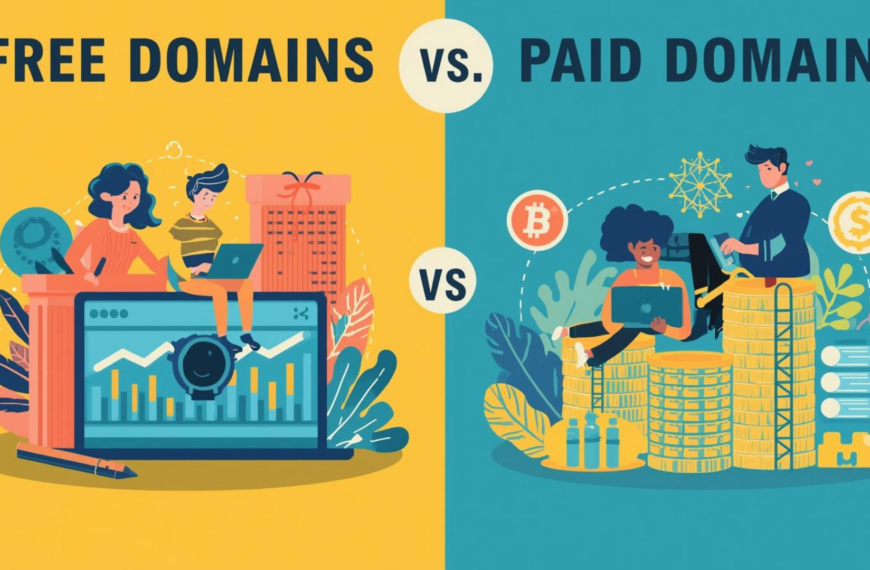
5) Using Free or Unreliable Domain Providers
Free domain offers from sketchy providers seem attractive.
But they have serious problems.
Many lack proper customer support, so when your domain stops working, no one responds to your emails.
Also, free domain providers often have unstable infrastructure. Thus, your domain might resolve one day and fail the next.
But not always, free domains!
Even paid but unreliable registrars create problems. Those offering domains at cheap deals annually often have poor uptime, terrible support, and surprise fees at renewal.
The good news is that at Truehost, we exist to provide solutions, not problems.
We’ve built our reputation on reliability and support because we’ve seen too many businesses burned by cut-rate providers.
6) Failing to Secure Domain Privacy Protection
When you register a domain, ICANN requires registrants to provide contact information such as name, address, phone, and email.
This information becomes publicly available through WHOIS databases unless you enable privacy protection.
Without privacy protection, you get spam emails, unsolicited marketing calls, and potential security risks.
Scammers harvest WHOIS data for phishing attempts. Competitors can see when your domain expires and potentially try to grab it.
For businesses, this means your business information is public, which might be acceptable, but for individuals and small startups, it’s a privacy concern.
7) Letting the Domain Registration Expire
Your domain’s expiry date passes, and you forgot to renew.
Within days, your website goes offline. Your email stops working. Customers can’t reach you.
By the time you notice, you’re in the grace period or worse, the redemption period with expensive recovery fees.
Some domains get snatched by automated systems the moment they expire, especially if they have any traffic or backlinks.
But the fix is simple! Enable auto-renewal immediately after registration.
That way, your registrar charges your payment method automatically before expiry, and no manual intervention is needed.
8) Registering Only One Domain Name Variation
You register “yoursite.in” and stop there.
You don’t grab “yoursite.com” or “your-site.in” or common misspellings.
Within weeks, someone else registers these variations, including competitors or domain squatters, which can either confuse your customers or hold them hostage for inflated prices.
So, the smart approach is to register multiple related domains when you register your primary one.
For instance, register your brand name across .in, .com, and .co.in at a minimum. Common misspellings of your brand name.
9) Using Hyphens and Numbers Unnecessarily
“Sharma-Solutions.in” or “Tech4U.in” cause problems when spoken aloud.
You tell someone your website in person. They hear “Sharma Solutions” without knowing about the hyphen.
Then, when they type “SharmaSolutions.in”, they nowhere or worse, on a competitor who registered the non-hyphen version.
Same problem with numbers. “Tech4U” becomes “TechForYou” or “TechFourU” depending on who’s typing.
So, when choosing a domain name, think about every context you’ll share it, including business cards, verbal conversations, radio ads, podcast interviews, and social media.
And if someone has to ask “is that with a hyphen?” or “is that the number 4 or the word four?”, you’re creating friction.
So, eliminate that friction by choosing clean, clear domains without these complications.
10) Not Owning the Domain Under Your Name or Business
The common scenario in India is that someone starts a business and asks their web developer to set everything up.
Then, the developer registers the domain in their own name.
Business grows. Relationship with developers sours.
Now you discover you don’t actually own your domain. The developer does.
They can hold it hostage. Charge you to transfer it. Refuse to give access.
You’re stuck.
Similar problems happen when partners register domains in personal names without clear agreements, or when employees handle registration using company accounts they control.
But the fix is simple! Always register domains in your business name if you’re operating as a formal entity.
If you’re a sole proprietor, register under your own name.
In addition, maintain direct access to the registrar account and don’t share master login credentials with contractors or employees.
11) Overlooking Renewal Costs and Hidden Fees
You saw a domain name selling at ₹99!” and registered it immediately.
What you didn’t see is that the renewal price is ₹1,199. Privacy protection adds ₹499. Email hosting costs another ₹999.
So, your ₹99 domain actually costs ₹2,697 annually ongoing.
This happens a lot cause many registrars advertise promotional first-year pricing prominently while hiding renewal rates in fine print.
Others add mandatory or default-selected add-ons at checkout that inflate costs.
Therefore, before completing any domain registration, check these specific items, including renewal price for year two and beyond, not just promotional first-year cost.
Also, check whether privacy protection is included or costs extra. Any automatically-selected add-ons you don’t need.
But the best thing is that at Truehost, we maintain transparent pricing without promotional gimmicks.
In other words, what you pay in year one is what you’ll pay in year five. No surprises.
12) Ignoring DNS and Nameserver Configuration
You registered the domain. Payment cleared. You received confirmation.
But your website still doesn’t work. Why?
DNS isn’t configured, meaning your domain is registered but not pointing anywhere.
This confuses many first-time registrants who assume registration automatically connects everything.
But the reality is that it doesn’t! You need to configure nameservers to point your domain to your hosting provider.
Here’s how you do it!
Your hosting provider gives you nameserver details, usually two addresses like ns1.yourhost.com and ns2.yourhost.com.
So, you enter these in your registrar’s domain management panel. Then you wait for DNS propagation, which takes anywhere from 1-24 hours.
Without this step, your domain exists but doesn’t resolve to any website.
13) Not Locking the Domain Against Unauthorized Transfers
Domain lock, also called transfer lock or registrar lock, prevents anyone from transferring your domain to another registrar without your explicit approval.
So, without it enabled, if someone gains access to your registrar account or forges transfer authorization, they can move your domain away from your control.
And once transferred, recovering your domain is difficult, time-consuming, and sometimes impossible.
Therefore, why wait for hackers to grab your domain, then get confused about where to start recovering?
Simply, ensure you enable domain lock.
Most registrars offer this feature for free. Some enable it by default. Others require you to manually activate it.
Plus, combine it with two-factor authentication on your registrar account for maximum protection against domain theft.
Conclusion
Domain registration isn’t complicated. But rushing through it without understanding the pitfalls costs time, money, and opportunities every single day.
The patterns are clear!
Choose simple, future-proof names, secure local extensions and variations, protect your ownership and privacy, understand all costs, and implement security measures.
Most of these steps take minutes during initial registration.
But above all, choose a reliable provider. Then, understand the registrar’s renewal costs, ease of configuring DNS properly, and availability of customer support in case your stack.
Fortunately, the search for the best domain registrars in India shouldn’t be a hassle.
At Truehost, we have a working and proper domain registration process.
Our platform highlights important settings during registration, and our support team answers questions before mistakes happen.
Interesting? Visit Truehost now and use these offers to register your domain the right way.