 Web HostingBudget-friendly shared hosting plans
 Domains SearchFrom .com to unique country domains, explore and register extensions worldwide.
 WordPress HostingPower your blog or business with WordPress hosting.
 Email HostingSimple, secure email hosting that helps you stay connected and professional.
 Reseller HostingStart your own hosting business with easy and reliable reseller hosting plans.
 AffiliateJoin our affiliate program and earn commissions every time you bring in new customers.
 cPanel HostingHosting powered by cPanel, the world’s most user-friendly control panel.
 Windows HostingBuilt for Windows applications and websites
 IN Domain PricesDon’t miss out on the best domain deals in India!
 WHOIS LookupFind out who owns a domain name with a quick and easy WHOIS search.
 Domain TransferTransfer your domain to us and enjoy reliable support every step of the way.
 .Com DomainGet the most trusted domain for worldwide credibility
 All TldsSearch and register domain extensions worldwide.
 SSL CertificatesProtect your website with trusted SSL certificates and keep customer data safe.
 VPS HostingPowerful virtual servers. Full root access. Reliable uptime.
 Managed VPS HostingNot a tech expert? Choose our fully managed VPS service.
 Dedicated ServersTake full power and total control of your own physical server.
 AI Website BuilderCreate stunning websites instantly with our easy AI builder.
 Online ShopBuild your eCommerce store easily, no coding, just growth.
 Web Design ServicesGet a website built for your brand and designed for your goals.
 Contact UsReach out to us for support or questions.
 SupportGet answers and how-to guides for all our services.
 BlogRead our latest blogs on web hosting, online business, digital marketing, and other helpful topics.
Ever tried visiting your website and got hit with a blank page or a “Server Not Found” error? Annoying, right?
For most domain owners, this is a classic DNS problem. It feels confusing, almost like a tech mystery.
But here’s the thing.
Most DNS errors are easier to fix than you think. Once you know what’s happening, solving them is straightforward.
And the best thing is that you’re in the right place.
In this guide, I’ll uncover common domain DNS errors, explain why they occur, and show how to resolve them quickly.
What is a DNS Error and What Causes It
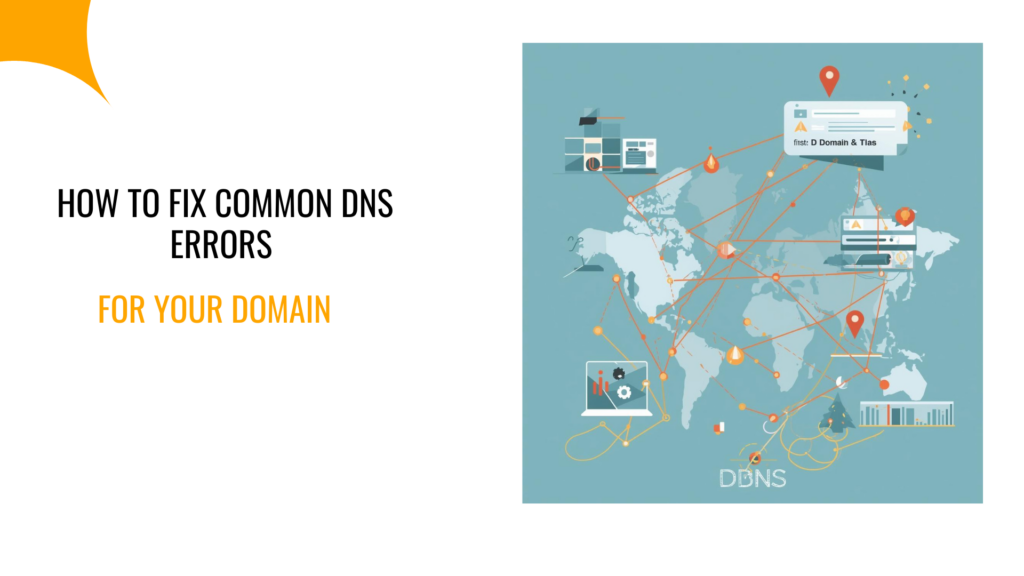
A DNS (Domain Name System) error occurs when your browser can’t resolve your domain name to the correct IP address.
Think of DNS as the Internet’s phonebook. It translates a domain name like yourwebsite.co.in into an address that computers understand.
When that translation fails, you get a DNS error.
So, what usually triggers these errors?
- Incorrect DNS records: Even a small typo in your A, CNAME, or MX records can prevent your domain from resolving. So, double-checking your entries is crucial.
- Expired domain or DNS hosting: If your domain registration or DNS hosting expires, your site becomes unreachable until you renew.
- Propagation delays: DNS changes don’t take effect instantly. It can take up to 48 hours for updates to propagate globally, which can make your domain temporarily unreachable.
- Server outages: Sometimes the issue is on your host’s or DNS provider’s side. Even reliable providers can have brief downtimes.
- Firewall or network issues: Local networks, routers, or firewalls can block DNS requests, making your domain appear offline even if everything else is fine.
Remember, understanding why a DNS error occurs is the first step to fixing it efficiently. Once you know the cause, you can take targeted action rather than guessing.
How to Diagnose DNS Problems Using Online Tools
You don’t need to be a tech expert to identify DNS issues. With the right tools, you can pinpoint the problem quickly and accurately.
For instance, here are some of the most effective ways to diagnose DNS problems:
- DNS Checker: This tool shows whether your DNS records are propagating correctly across different regions. It’s perfect for checking if recent changes are live worldwide.
- Ping and Traceroute: Simple yet powerful. Ping tests if your server is reachable, while Traceroute maps the path your request takes. Tools like Pingdom or your system’s terminal can reveal network delays or blocks.
- WHOIS Lookup: Unsure if your domain registration is active? WHOIS lookup confirms your domain status, expiration date, and registrar information.
- DNS Lookup Tools: Services like MXToolbox allow you to check A, CNAME, MX, and TXT records. Misconfigured records are often the main cause of DNS errors.
- Browser Diagnostics: Modern browsers like Chrome have built-in developer tools. So, you can inspect network requests and see where DNS resolution is failing, which helps identify whether the issue is local or server-side.
In summary, using these tools helps you determine exactly where the problem lies.
Whether it’s your domain, your hosting server, or even the user’s network, you can easily find the cause without trial and error.
Quick Fixes for the Most Common DNS Errors
Some DNS errors show up more often than others, but the good news is that most can be resolved quickly if you know what to do.
Let’s walk through the ones you’re most likely to encounter.
1) DNS_PROBE_FINISHED_NXDOMAIN
This error occurs when your domain can’t be resolved, usually because of incorrect A or CNAME records.
So, start by reviewing your DNS entries carefully.
Ensure your A record points to the correct IP and that CNAME records are accurate.
After updating, clear your browser cache and flush the DNS cache with ipconfig /flushdns on Windows or dscacheutil -flushcache on Mac.
That way, it helps your system recognize the changes immediately.
2) DNS_PROBE_FINISHED_NO_INTERNET
If your system can’t reach the DNS server, this error pops up. It often indicates network issues.
But you can easily fix it by checking your internet connection and restarting your router if needed.
If the problem persists, switching to reliable public DNS servers like Google DNS (8.8.8.8 / 8.8.4.4) can help your system reconnect smoothly.
3) SERVER_NOT_FOUND
Sometimes, the domain itself may be unreachable. This can happen if your registration has expired or the DNS hosting service is temporarily down.
So, to fix this issue, confirm that your domain registration is active and check your DNS hosting status.
But if downtime is frequent, consider moving to a more reliable provider like Truehost to minimize disruptions.
4) TIMEOUT or SERVFAIL
When a DNS server is slow or unresponsive, you may see these errors.
That means a fast, stable DNS provider can prevent these delays and hence resolve the DNS error issue.
You can also adjust the TTL (Time to Live) temporarily to speed up the propagation of corrected records. This ensures your changes take effect faster across the internet.
5) Misconfigured MX Records
Email delivery issues often stem from misconfigured MX records.
So, having issues with email delivery? Double-check that your MX records match your email hosting provider’s requirements.
Configuring SPF, DKIM, and DMARC records correctly also improves deliverability and reduces the chances of your emails landing in spam.
How Truehost Helps with Common DNS Errors
At Truehost India, we make DNS management simple. Here’s how we help:
- DNS management dashboard: Update A, CNAME, MX, and TXT records without the tech headache.
- Reliable DNS hosting: India-focused servers reduce downtime and propagation delays.
- Expert support: Our team troubleshoots errors fast, from misconfigured records to propagation issues.
- Automated monitoring: We track DNS status and alert you if something goes wrong.
Overall, with Truehost, most DNS issues are resolved within minutes. So, your website stays online, accessible, and stress-free.
Final Thoughts
DNS errors happen. But they don’t have to throw your entire website off balance.
Most issues come from simple things, from wrong records, expired domains, or slow DNS servers.
But once you know what to check, the fixes are quick.
Stay proactive. Review your DNS settings regularly. Keep your domain and hosting active. And use providers that keep things fast and stable.
However, if you ever feel stuck, that’s where expert support makes a real difference.
At Truehost, we step in fast, diagnose the problem, and help you get things back online without the stress.
Interesting? Move your domain or website to Truehost and enjoy a DNS error-free online presence for your website!