 Web HostingBudget-friendly shared hosting plans
 Domains SearchFrom .com to unique country domains, explore and register extensions worldwide.
 WordPress HostingPower your blog or business with WordPress hosting.
 Email HostingSimple, secure email hosting that helps you stay connected and professional.
 Reseller HostingStart your own hosting business with easy and reliable reseller hosting plans.
 AffiliateJoin our affiliate program and earn commissions every time you bring in new customers.
 cPanel HostingHosting powered by cPanel, the world’s most user-friendly control panel.
 Windows HostingBuilt for Windows applications and websites
 IN Domain PricesDon’t miss out on the best domain deals in India!
 WHOIS LookupFind out who owns a domain name with a quick and easy WHOIS search.
 Domain TransferTransfer your domain to us and enjoy reliable support every step of the way.
 .Com DomainGet the most trusted domain for worldwide credibility
 All TldsSearch and register domain extensions worldwide.
 SSL CertificatesProtect your website with trusted SSL certificates and keep customer data safe.
 VPS HostingPowerful virtual servers. Full root access. Reliable uptime.
 Managed VPS HostingNot a tech expert? Choose our fully managed VPS service.
 Dedicated ServersTake full power and total control of your own physical server.
 AI Website BuilderCreate stunning websites instantly with our easy AI builder.
 Online ShopBuild your eCommerce store easily, no coding, just growth.
 Web Design ServicesGet a website built for your brand and designed for your goals.
 Contact UsReach out to us for support or questions.
 SupportGet answers and how-to guides for all our services.
 BlogRead our latest blogs on web hosting, online business, digital marketing, and other helpful topics.
Ever wondered why some websites load smoothly while others take forever, or why some sites can’t even go live?
It all comes down to two things: a web server and web hosting.
People often confuse the two.
You might hear someone say “I need web hosting” when they really mean a server, or vice versa.
And that confusion can lead to buying the wrong service or paying more than you need.
In this guide, I’ll break down the difference between a web server and web hosting, the types available in India, their pros and cons, and how to choose what’s right for you.
Keep reading to find out.
What Is a Web Server?
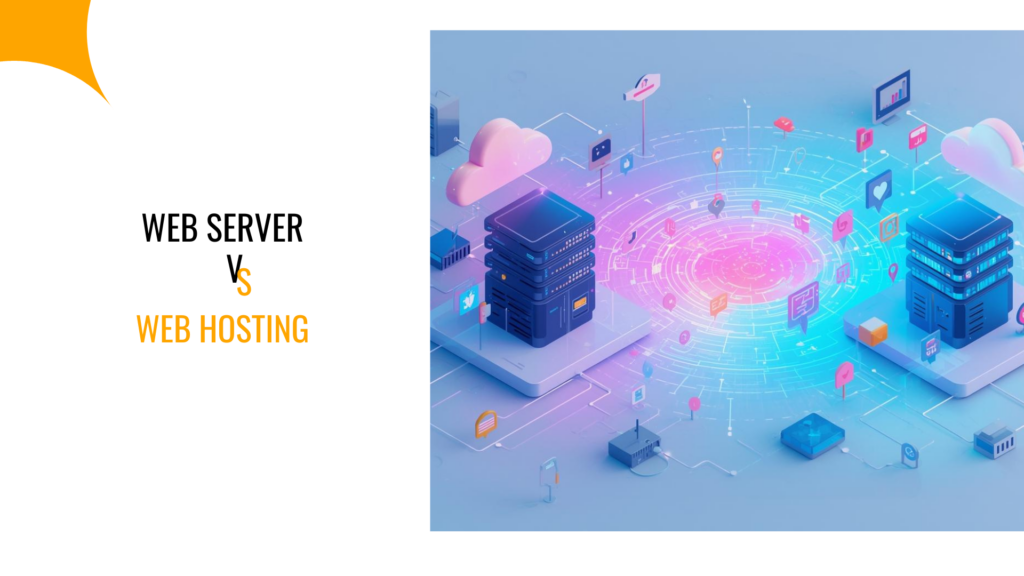
A web server is basically the hardware or software that stores, processes, and delivers your website’s files to visitors.
Whenever someone types your domain name in a browser, the web server sends the requested files (HTML, images, CSS, etc.) so the site appears on their screen.
In short, when you hear of a web server, think of it like an engine that:
- Stores website files.
- Responds to browser requests.
- Manages traffic, security, and protocols like HTTP/HTTPS.
Types of Web Servers in India
The kind of server you choose affects how your website loads for the end user.
In short, different servers handle traffic, speed, and processing differently, and choosing the right one can make a noticeable difference.
So, let’s break down the main types you’ll actually come across in the Indian hosting market.
1) Apache Web Server
Apache is one of the most familiar names in the hosting world.
If you ask any small business owner or beginner blogger in India what their site is running on, there’s a good chance it’s Apache.
That’s because Apache is an open-source, well-supported, and it works with almost any operating system you can think of.
It’s great for:
- Small to medium websites
- Beginners using PHP apps or WordPress
- Websites that don’t expect heavy traffic
Plus, Apache is flexible, reliable, and widely supported by most Indian hosting providers, including Truehost.
2) Nginx
If Apache is the all-rounder, Nginx is the performance-focused option.
You’ll often see Indian eCommerce brands, OTT platforms, or growing SaaS companies rely on it because of its ability to handle high traffic with ease.
It is known for:
- Faster response times
- Strong performance during traffic spikes
- Efficient resource usage
So, if you’re expecting thousands of visitors at the same time, maybe during a sale or campaign, Nginx performs far better than traditional setups.
3) LiteSpeed
LiteSpeed is increasing in popularity in India, especially for users running WordPress.
While it’s a paid server software, many hosting companies now offer it as part of their plans because of how well it improves website performance.
You’ll definitely love LiteSpeed web server because it’s:
- Built-in caching that boosts WordPress speed
- Efficient handling of dynamic sites
- Lightweight and extremely fast
That means if you want a quick fix for slow-loading WordPress pages without deep technical work, LiteSpeed is a solid choice.
4) Microsoft IIS
IIS (Internet Information Services) is Microsoft’s web server, and it’s mainly chosen by developers building on the Windows ecosystem.
You’ll find it used by:
- Government portals
- Enterprise apps
- Companies using ASP.NET or MSSQL environments
This is because IIS integrates seamlessly with Microsoft technologies, making it ideal for organizations that rely heavily on Windows-based applications.
What are the Advantages of a Web Server over Web Hosting
A web server boasts advantages that a regular web hosting service can’t match
Here’s a simple comparison:
| Web Server | Web Hosting |
| Full control over hardware and software | Limited control, meaning you can’t tweak server-level settings or install advanced custom software |
| Handles high traffic efficiently, hence ideal for large websites, eCommerce stores, or apps | Shared resources can slow down your website if other sites on the server use too much |
| Dedicated resources. CPU, RAM, and storage are fully yours for faster load times | Resources are often shared, so speed and performance can fluctuate |
| Advanced customization. Install scripts, security tools, or software tailored to your needs | Many advanced scripts or custom software may not be supported |
Therefore, if you’ve an Indian business website that experiences traffic spikes during festive sales or exam seasons, a web server ensures the site stays fast and reliable.
That’s unlike web hosting, which is easier and cheaper, but cannot outdo these web server advantages.
What are the Disadvantages of a Web Server compared to Web Hosting
On the flip side, web servers aren’t perfect. Here’s why web hosting can sometimes be a better choice:
| Web Server | Web Hosting |
| Setting up and maintaining your own server can be expensive | You pay only for the hosting plan with no hardware maintenance |
| Requires technical knowledge to configure, secure, and manage the server | Beginner-friendly |
| Maintenance responsibility, including updates, patches, and backups, is all on you | Managed for you by the hosting providers |
| No bundled services, such as email accounts, SSL certificates, and control panels | Comes with extras, including email, SSL, control panels, and customer support |
For many Indian startups and small businesses, these disadvantages make web hosting the practical choice. You get the benefits of a server without the stress of managing it yourself.
What Is Web Hosting?
Web hosting is a service that stores your website files on a server and makes them accessible to the internet.
When you buy web hosting, you’re essentially renting space on a server, along with additional services like support, email accounts, and control panels.
Think of web hosting as the home for your website. The server is the engine, and hosting is the house where everything lives.
In summary, web hosting is characterized by:
- Being managed by companies that handle server maintenance.
- Offering different plans depending on your traffic and resource needs.
- Providing extra features like backups, security, and easy domain management.
Types of Web Hosting in India
Choosing the right web hosting starts by understanding the various types that exist, so you can know which one serves the needs of your site best.
That said, here are the most popular web hosting types you need to be aware of:
1) Shared Hosting
If you’re just starting, this is the easiest way in.
Here, multiple websites share the same server, which keeps costs low. So, it’s perfect for small blogs, personal sites, or anyone who wants a simple setup.
And the best part is, at Truehost, our shared hosting plans give you everything you need to get online quickly, without worrying about the technical side.
2) VPS Hosting (Virtual Private Server)
Need more power as your site grows? VPS divides a server into virtual environments, giving your website dedicated resources.
This means better performance and faster load times than shared hosting.
Therefore, for your growing business or e-commerce store that expects higher traffic and needs more control, VPS hosting is a good choice in India.
3) Cloud Hosting
Traffic spikes can be unpredictable, especially for startups.
That’s why cloud hosting spreads your site across multiple servers, making it scalable and reliable.
This is ideal for fast-growing businesses or websites that see fluctuating visitor numbers, and at Truehost, we offer managed cloud hosting to ease the management of the server for you.
4) Dedicated Hosting
Here, you get the entire server to yourself. That means full control, maximum performance, and no sharing with anyone else.
Hence, dedicated hosting is best for large websites, high-traffic portals, or enterprises that demand top speed and security in India.
5) WordPress Hosting
If WordPress is your platform of choice, this is the easiest route.
WordPress hosting is optimized for speed, security, and updates.
Plus, if you choose a managed WordPress hosting from a reliable provider like Truehost, activities like backups, patches, and maintenance are taken off your shoulders.
What are the Advantages of Web Hosting over a Web Server
Running your own web server sounds tempting with full control and custom setup.
However, web hosting often makes more sense, especially if you’re looking for simplicity and support.
Here’s why:
| Web Hosting | Web Server |
| You pay only for the hosting plan, no expensive hardware to buy or maintain | Setting up a server can cost thousands, plus ongoing maintenance |
| Technical support included | You’re on your own, meaning any server issues are your responsibility |
| Easy setup | Setup requires technical knowledge, from installing software to configuring security |
| Hosting often comes with email, SSL certificates, backups, and security features | You need to arrange all these separately, which can get complicated and expensive |
| Has scalable plans | Scaling your server usually means buying new hardware or extensive reconfiguration |
In short, with web hosting, you get a ready-to-use solution with support, security, and flexibility.
That’s unlike running your own server, which can be powerful, but it’s time-consuming, costly, and technically demanding.
What are the Disadvantages of Web Hosting compared to a Web Server?
Web hosting is convenient, but it’s not perfect. There are trade-offs to consider, especially if you need full control or advanced setups for your website in India.
Let’s break it down:
| Web Hosting | Web Server |
| Limited control | Running your own server gives you complete control over software, security, and settings |
| Your site’s performance can dip if other websites on the same server consume a lot of resources | A dedicated server avoids this issue, offering consistent performance |
| Certain custom scripts or configurations may not be supported | You can install anything you want on your own server |
| Downtime, policy changes, or maintenance by your host can affect your site | You control uptime and maintenance on your own server |
So, web hosting is perfect for convenience and simplicity.
However, if you need full control, top performance, or specialized setups, a dedicated web server might be the better choice.
Key Differences Between Web Server and Web Hosting
It’s easy to mix up a web server and web hosting, especially when you’re new to website hosting and ready to launch your first site or app.
But don’t worry!
The difference between the two is mainly in the features, as summarized in the table below:
| Feature | Web Server | Web Hosting |
| Definition | The hardware or software that serves website files | A service that stores your website files and makes them accessible online |
| Control | Full control over configuration and software | Limited control, as it depends on your hosting plan |
| Technical knowledge | Requires advanced skills to manage and troubleshoot | Beginner-friendly because the provider handles updates and maintenance |
| Cost | High, plus maintenance and setup expenses | Lower, with predictable monthly or annual plans |
| Resources | Dedicated to a single server or setup | Can be shared or dedicated, depending on the plan |
| Extras | Usually, no extra services are included by default | Often comes with email, SSL certificates, backups, and support |
In short, the web server is the engine powering your website, while web hosting is the service that packages that engine so you can run your site easily.
How Web Servers and Web Hosting Work Together
The truth is that you usually need both a web server and web hosting. They complement each other.
In short, a web server provides the power and processing to run your website.
The web hosting, on the other hand, provides the space, management, and accessibility so your site can actually reach visitors.
Think about it like this:
- If you run a blog, your files live on a server somewhere in a data center.
- Your hosting plan makes sure those files are served reliably. It also gives you a control panel, backups, SSL certificates, and other features that make managing your site easy.
Therefore, without a server, hosting has nothing to store your site on.
Likewise, without web hosting, a server requires you to handle everything yourself, from setup to maintenance, which can be overwhelming if you’re just starting.
When You Need Only a Web Server vs When You Need Web Hosting
Not every website needs both a server and web hosting, and picking the right option can save you time, money, and frustration.
So, when do you actually need just a web server? Here‘s when:
- Large websites or apps, such as enterprise systems and high-traffic platforms.
- Need full control, including to tweak every setting, run custom software, and manage everything yourself.
- You have technical know-how on security, updates, and traffic spikes.
On the flip side, a web server gives power.
But with great power comes maintenance. You’ll need the skills to keep everything running smoothly.
Therefore, you will basically need a web hosting service if:
- You’re a small business, blogger, or startup.
- You want an easy setup and minimal maintenance.
- You want support, backups, and extras bundled.
In summary, for most beginners and SMEs in India, web hosting gives everything you need. You can get online fast, stay secure, and skip the technical headaches.
On the other hand, you’ll need a web server if you want to have more power and custom settings of your own wish.
Final Verdict: Which One Should You Choose for Your Website?
Here’s the bottom line. Understanding the difference between a web server and web hosting can save you time, money, and stress.
For instance, web servers give you full control, dedicated resources, and high performance. But they’re expensive and technical.
In contrast, web hosting is affordable, beginner-friendly, and includes support, backups, and extras. However, it gives you limited server-level control.
But where do you start?
For most small businesses and new websites in India, web hosting is the smarter, more practical choice. You get reliability, security, and peace of mind without the technical headaches.
And the good news is that, at Truehost, we offer web hosting plans that scale with your needs from startups to growing enterprises.
Ready to get your website online the right way? Gran these web hosting offers while they last!